IDM Records: the music label of the new internet
Every trade is a note.
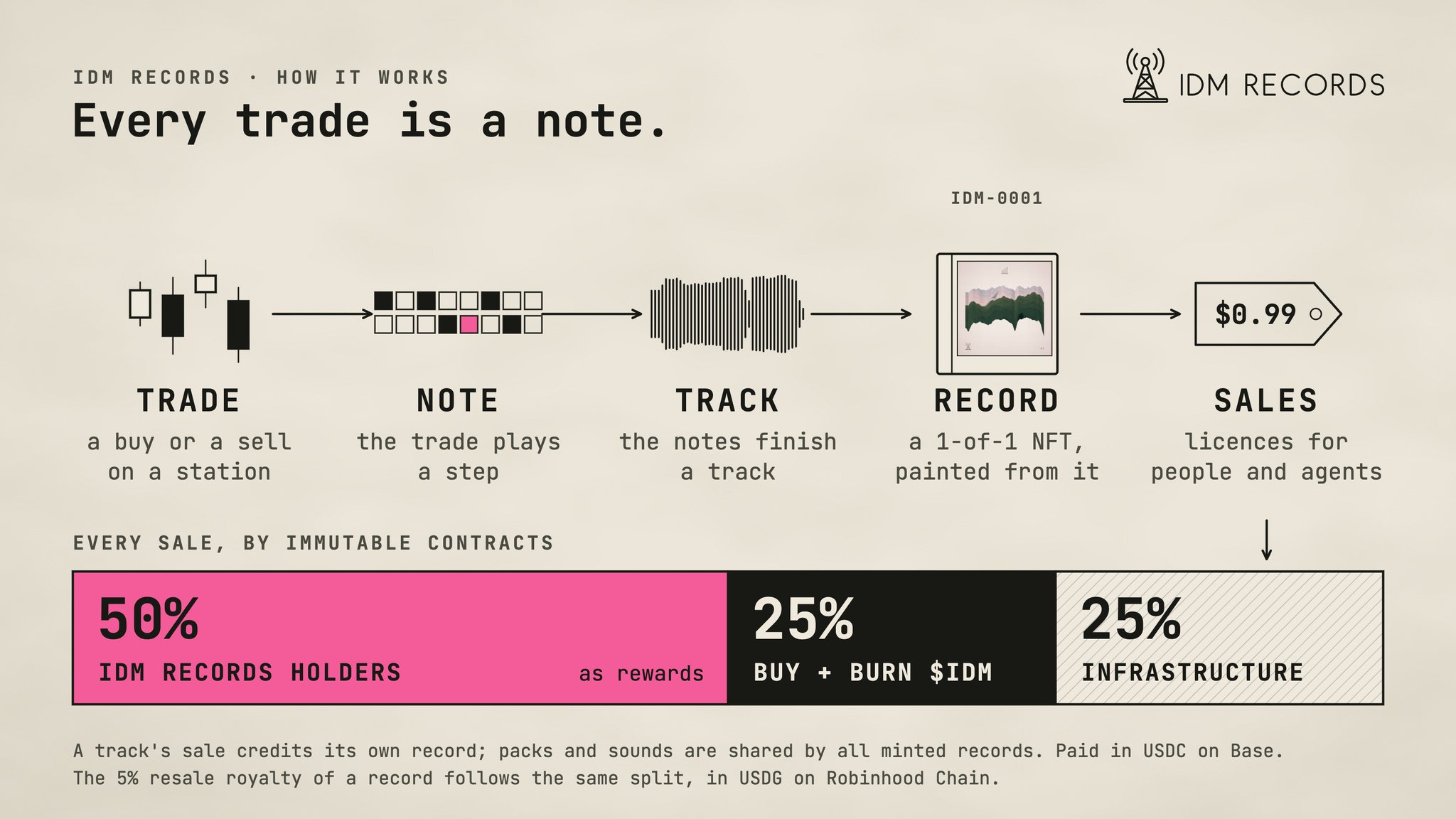
This is how IDM started: a radio station that turned token trades into music in real time, note by note. A buy is a note. A sell is a note. Big moves change the key. When the market goes quiet, so does the music. When activity picks up, the track gets more powerful.
Now the radio is becoming a music label of the new internet. Meet IDM Records.
why the new internet needs this
Thanks to AI agents, creating content has become much easier. And users are asking one question more and more often: where do we get the sounds?
Your AI agent made a promo video? Now you need to find background music, download it, add it to your project, and ask the agent to put it into the video. Too much extra work. The agent made the video in 5 minutes, but you spent another 30 looking for the right track.
It’s even harder for mobile app and game developers. They need dozens of different sounds, and finding the right ones can take hours or even days.
We are now in a situation where the bottleneck is in a completely unexpected place: sound.
AI agents can already pay for services on their own, so why not let them handle the entire process of working with sound?
Traditional music labels sell music through traditional channels, and only to people.
IDM Records targets two audiences at once: AI agents and people.
And now, you have a chance to become part of the label and earn from its sales.
where it all started: stations
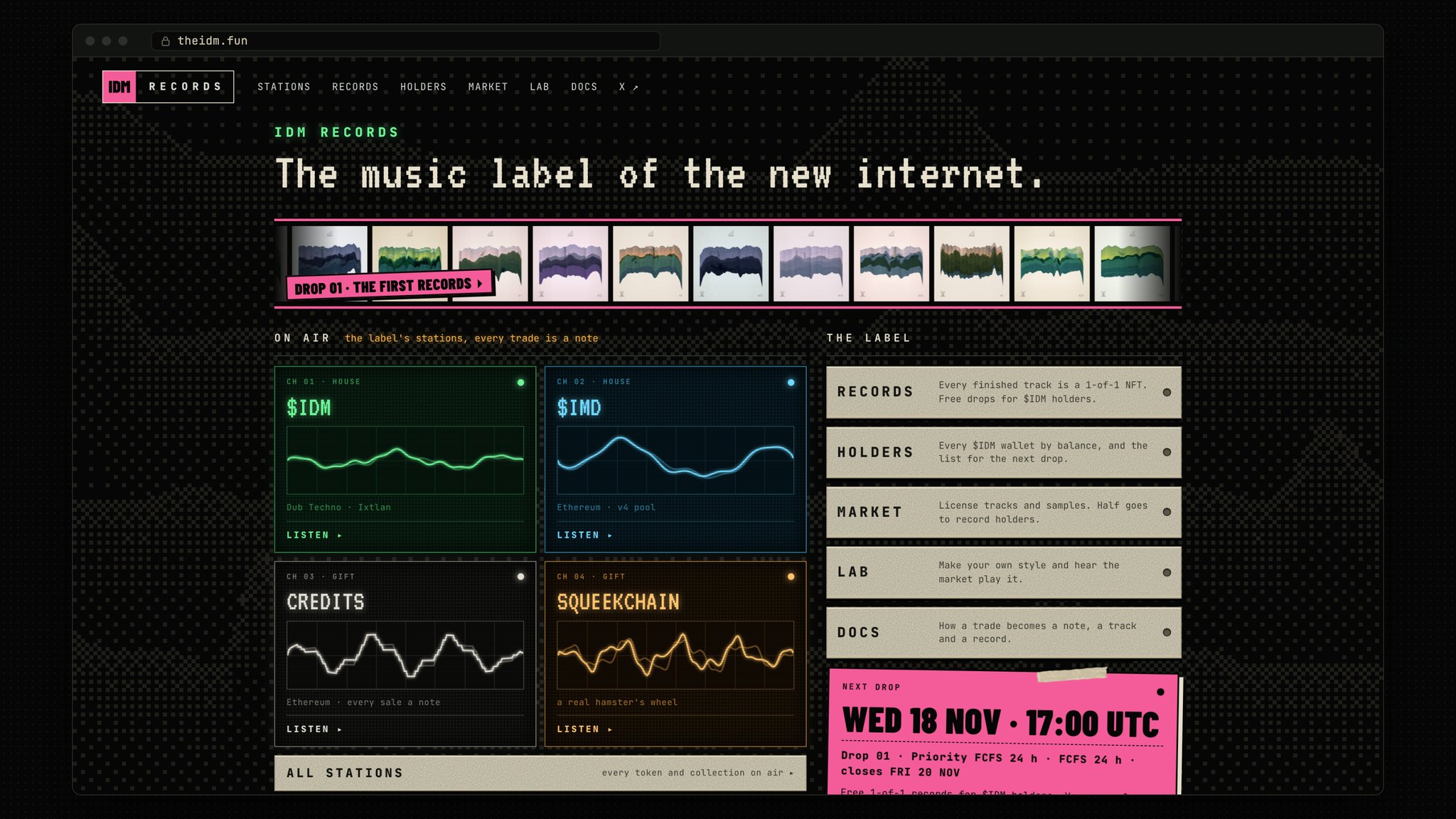
Homepage: the label and its stations
A station listens to token trades and plays them as music. Its sequencer turns every swap into a step. The swap size controls the volume, and its direction determines the note. Large moves change the key. Once enough notes have been played, the track ends and the next one starts in a new key.
The $IDM station plays track #4 using its real trades
Other stations play different tokens and collections. Any token or NFT project can apply for its own station, and its trades will become music too.
Each station has its own genres and styles. Every style is used only once per station, so every track in the catalog sounds different.
records
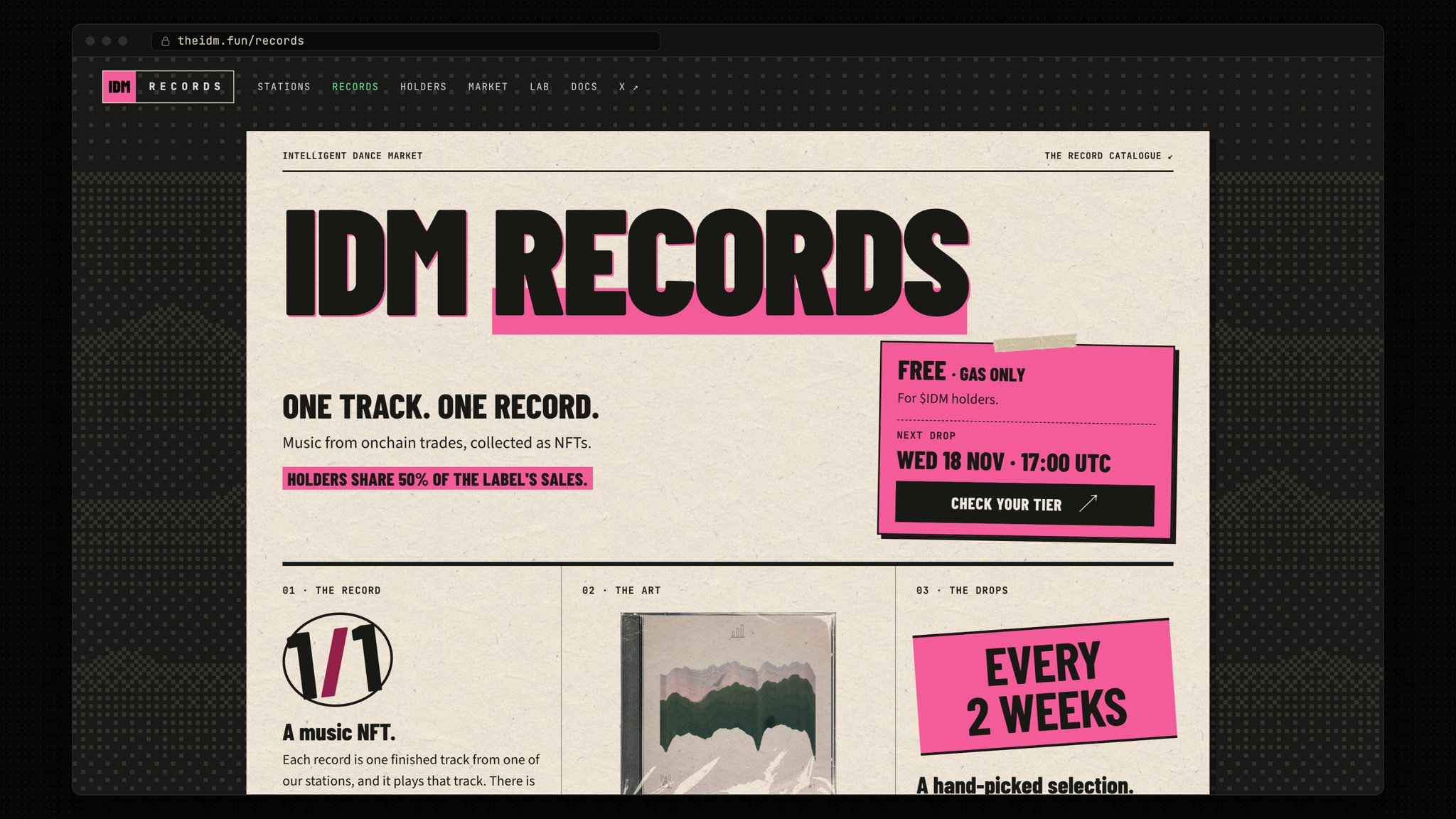
IDM Records: one track, one record
Every finished track becomes a record: a unique NFT in the IDM Records collection. There will be no more than 1,000 records in total.
The process of creating each NFT
Each record looks like a CD case. The cover shows a landscape generated from the track’s own data. The track data is hashed, the hash becomes a seed, and the seed determines the color palette, sky, ground, and radio tower.
Then the generator paints the picture stroke by stroke. Brush bristles, charcoal, airbrush, all created with code. The stripe on the cover follows the track’s real volume curve from beginning to end.
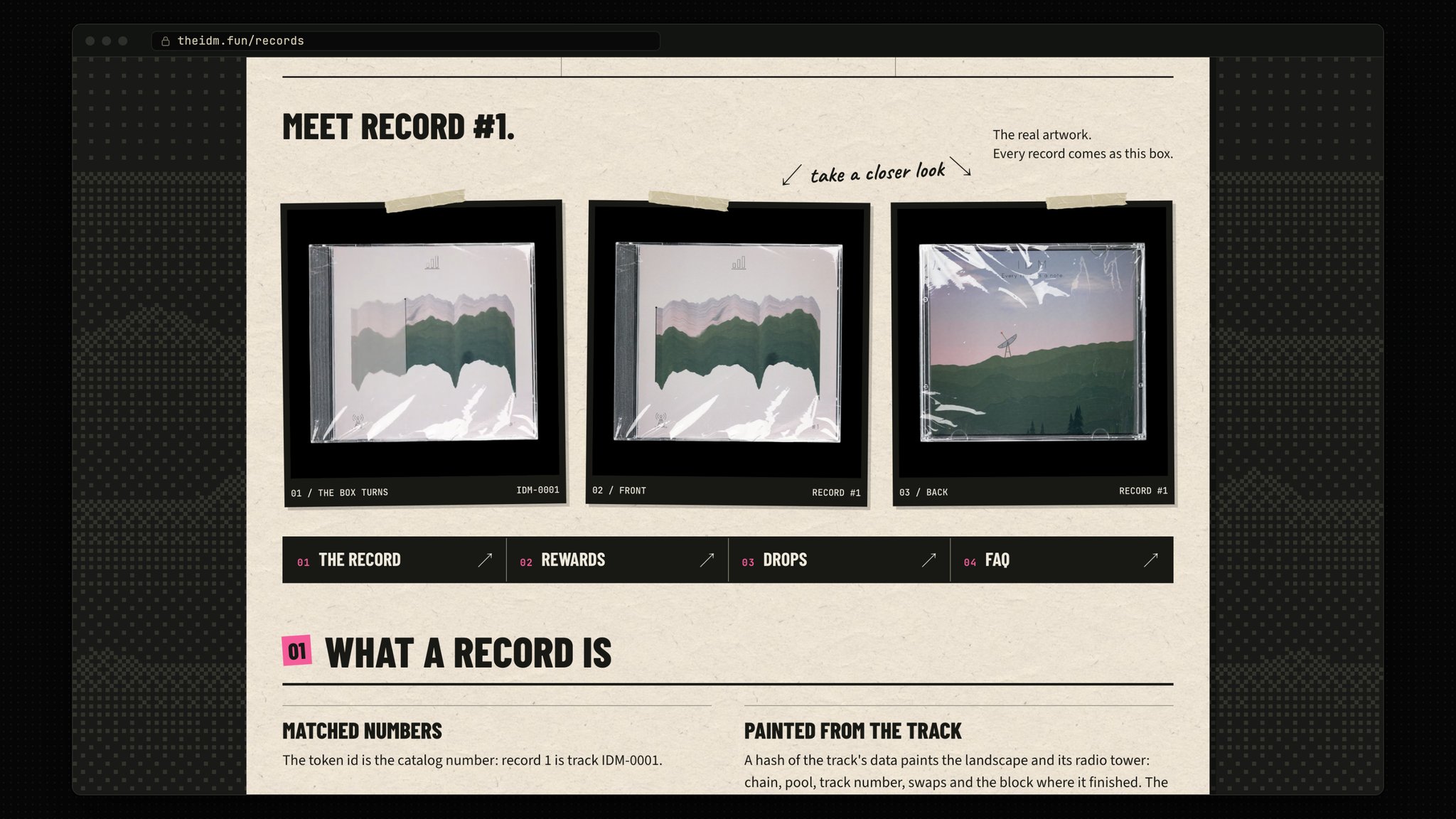
Record #1: CD case, front and back
Record #1 is “Slow Rubber” created from 85 trades on the $IDM station.
the mint
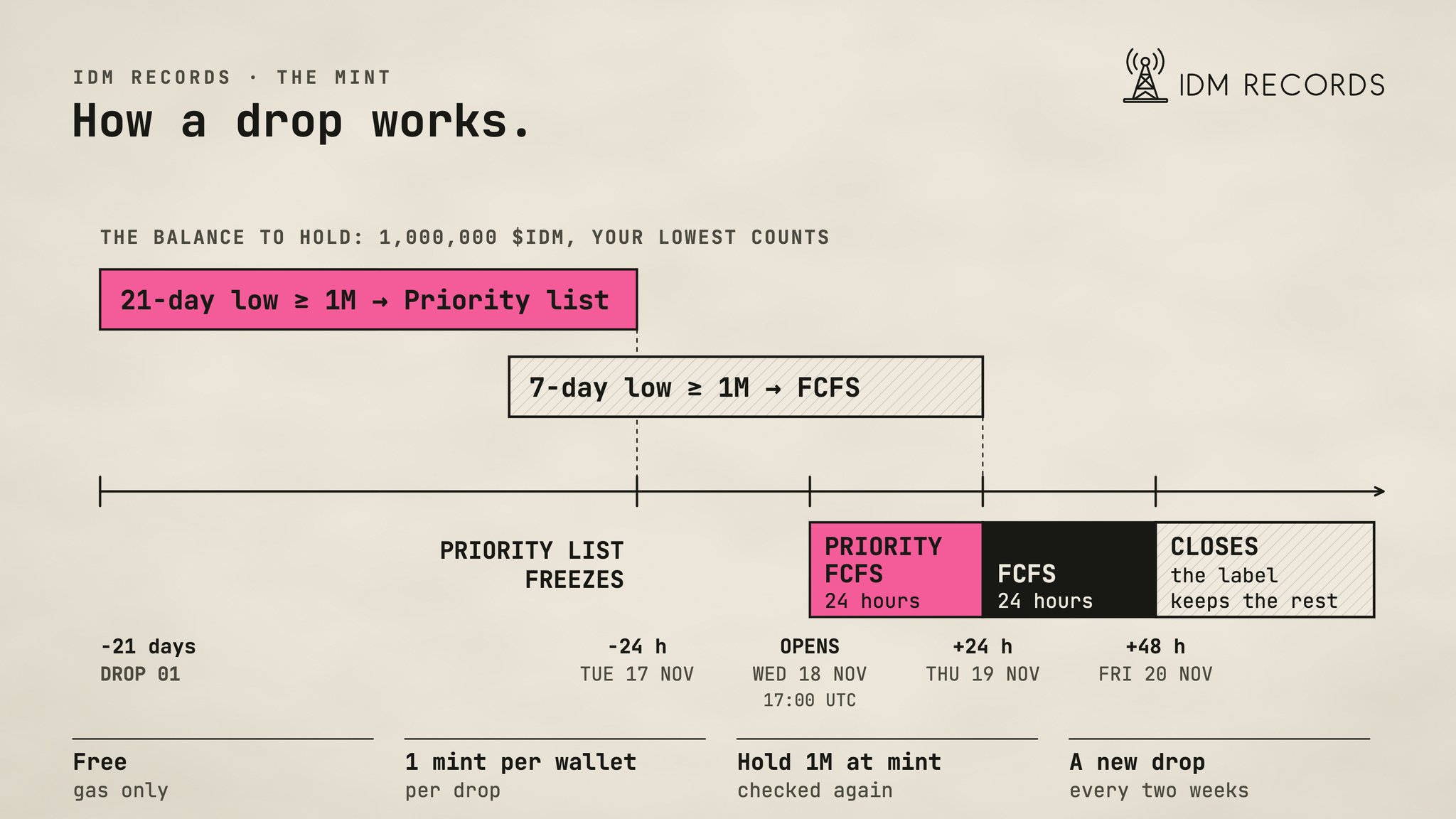
How the drop works
To be eligible for minting, you need to hold at least 1 million $IDM for a certain period of time.
Records are minted in drops every two weeks. Minting is free. You only pay gas on Robinhood Chain.
One mint per wallet per drop, but holders can participate in every drop. Just keep holding $IDM.
What holding a record gives you:
- Rewards from every sale. 50% of label sales go to holders. Revenue from packs and sounds is shared across all records. Payments go straight to your wallet: USDC for sales, USDG for resale royalties.
- A share of resales. Every resale has a 5% royalty, distributed the same way.
- Station subscriptions. 25% of revenue from Station subscriptions goes to NFT holders.
- A license for your track. While you hold the record, you can use its track for free in commercial projects: videos, ads, games, and apps.
- The record itself. Procedurally generated art created with JavaScript using the track’s parameters.
To mint in every drop, hold $IDM. Your lowest balance over the last 21 or 7 days is what counts:
- Priority FCFS: your lowest balance over the last 21 days is at least 1,000,000 $IDM. Mint in the first 24 hours of the drop: first come, first served, while records last.
- FCFS: your lowest balance over the last 7 days is at least 1,000,000 $IDM. The next 24 hours after the Priority window, while records last. The drop closes after 48 hours.
The rules in simple terms:
- The Priority list is locked 24 hours before the drop opens.
- More wallets can qualify than a drop has records, so both windows are first come, first served. Mint early.
- Buying right before the drop or moving tokens between wallets won’t help. Your lowest balance is what matters.
- Keep your balance until you mint. The contract checks it again, even if you’re on the Priority list.
- Priority FCFS and FCFS count together. One mint per wallet per drop.
- The label keeps 3 random records from every drop, drawn from a block hash at opening, and any record not minted in 48 hours. They go to giveaways, rewards and collaborations.
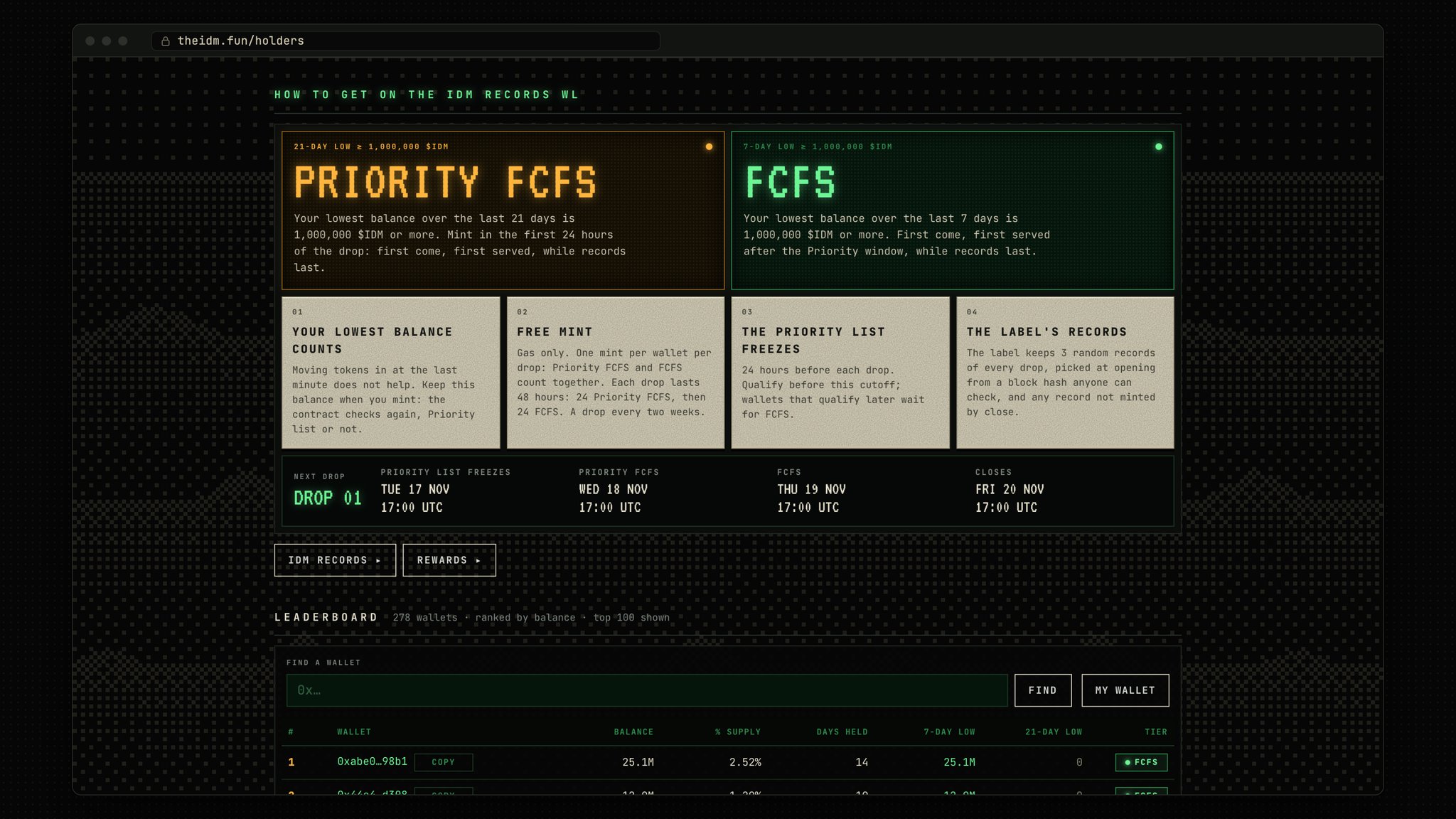
Holder leaderboard and whitelist rules
The holder leaderboard shows every wallet’s lowest balance over 7 and 21 days, along with its status. You can check your eligibility before the drop.
Drop 1: Wednesday, November 18, 17:00 UTC. 50 handpicked tracks, one for each style. Holders who have been holding since the launch will have completed their 21 days by the snapshot.
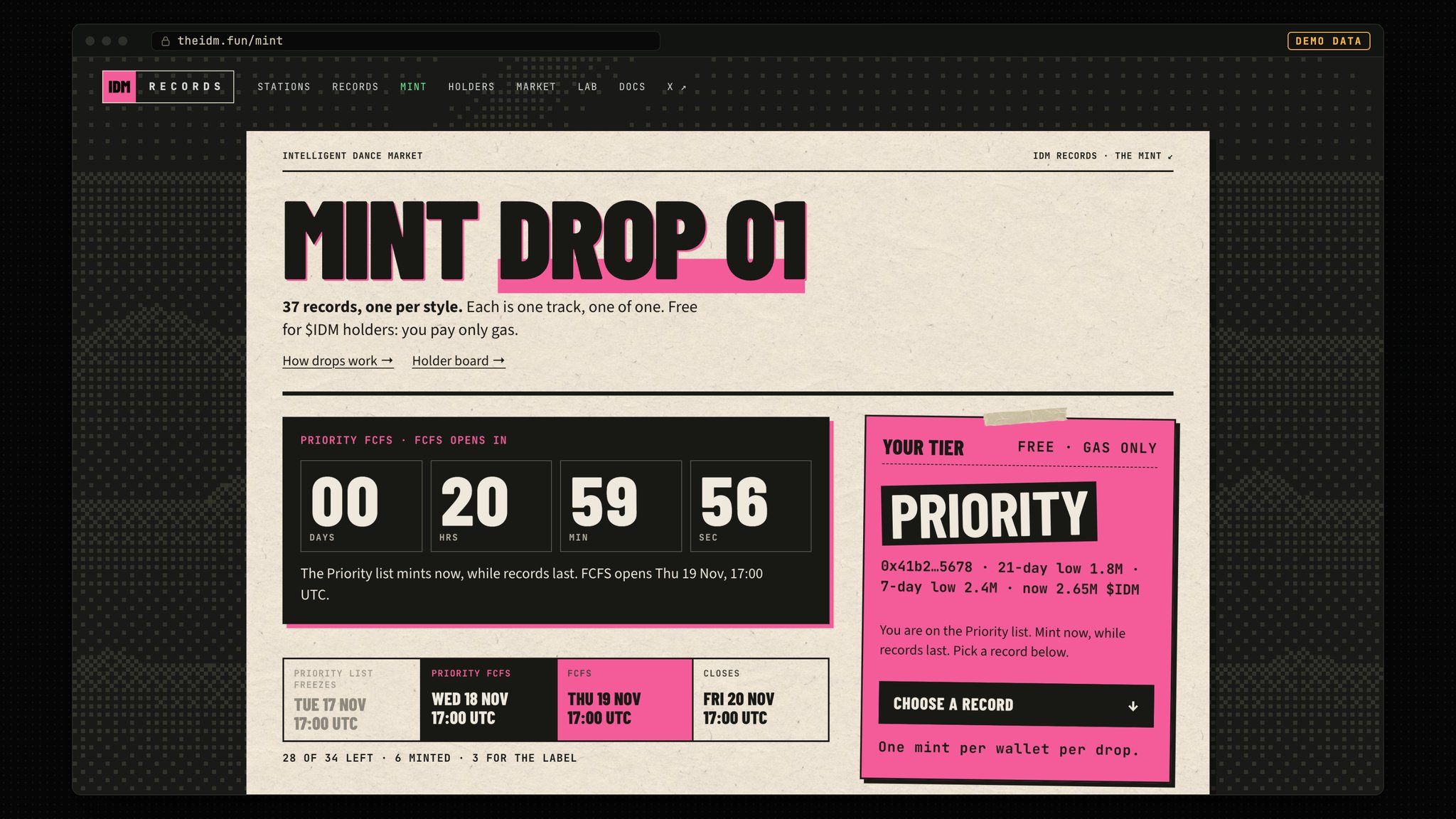
Preview of the mint page
where the money goes
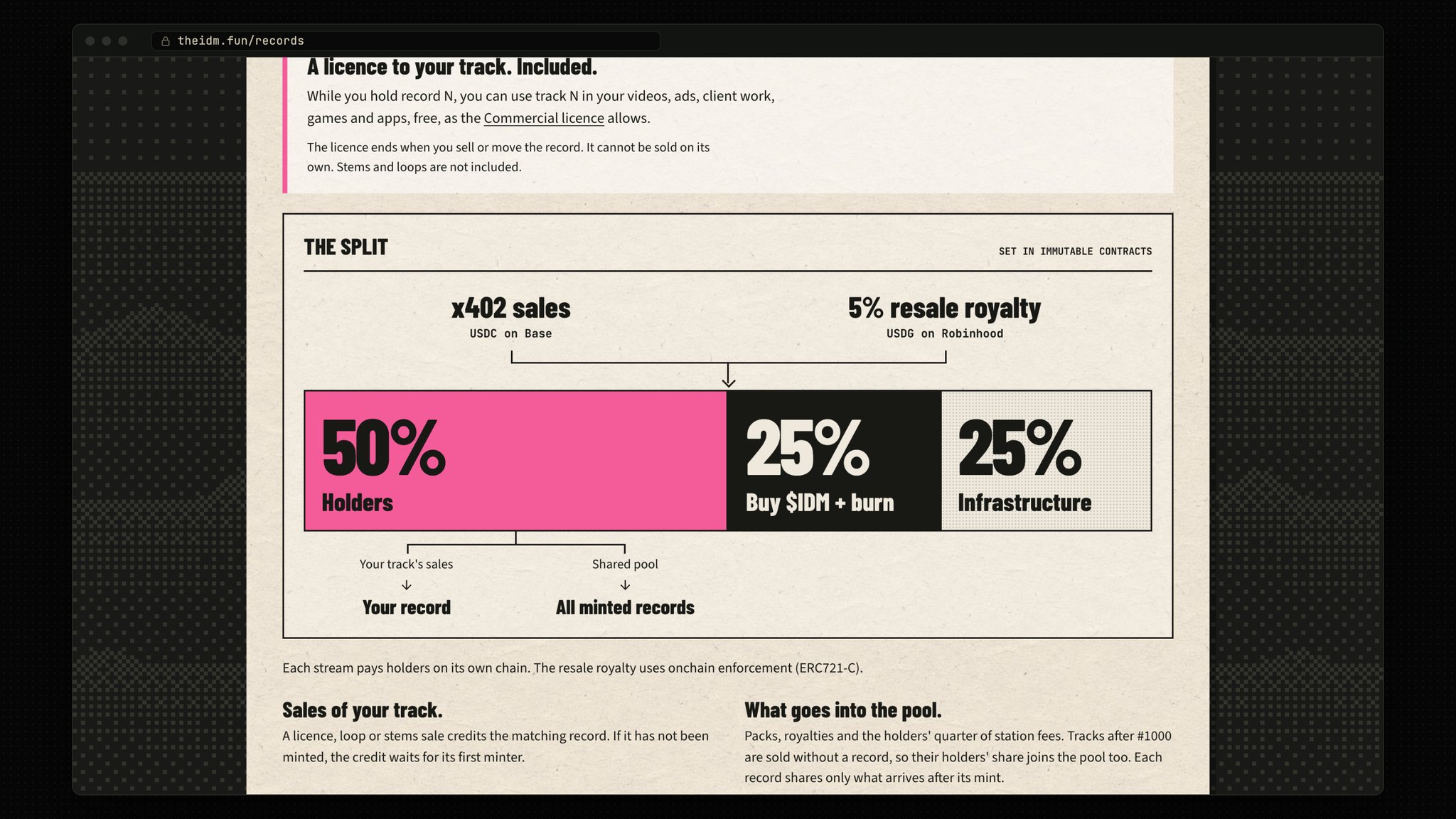
Every sale, from a person or an agent, goes into immutable contracts with no owner:
- 50% to IDM Records holders as rewards. A track’s sale goes to the holder of its record. Packs and sounds are split across all minted records.
- 25% buys back $IDM and burns it.
- 25% goes to infrastructure.
Sales rewards arrive in USDC on Base, straight to the holder’s wallet, from $1, with no staking and no claiming. Record resales carry a 5% royalty, split the same way. It collects in USDG in the records contract on Robinhood Chain: claim it whenever you like, and anything unclaimed moves with the NFT.
We don’t promise anything: no sales, no rewards. A record is not a share in a company.
the store
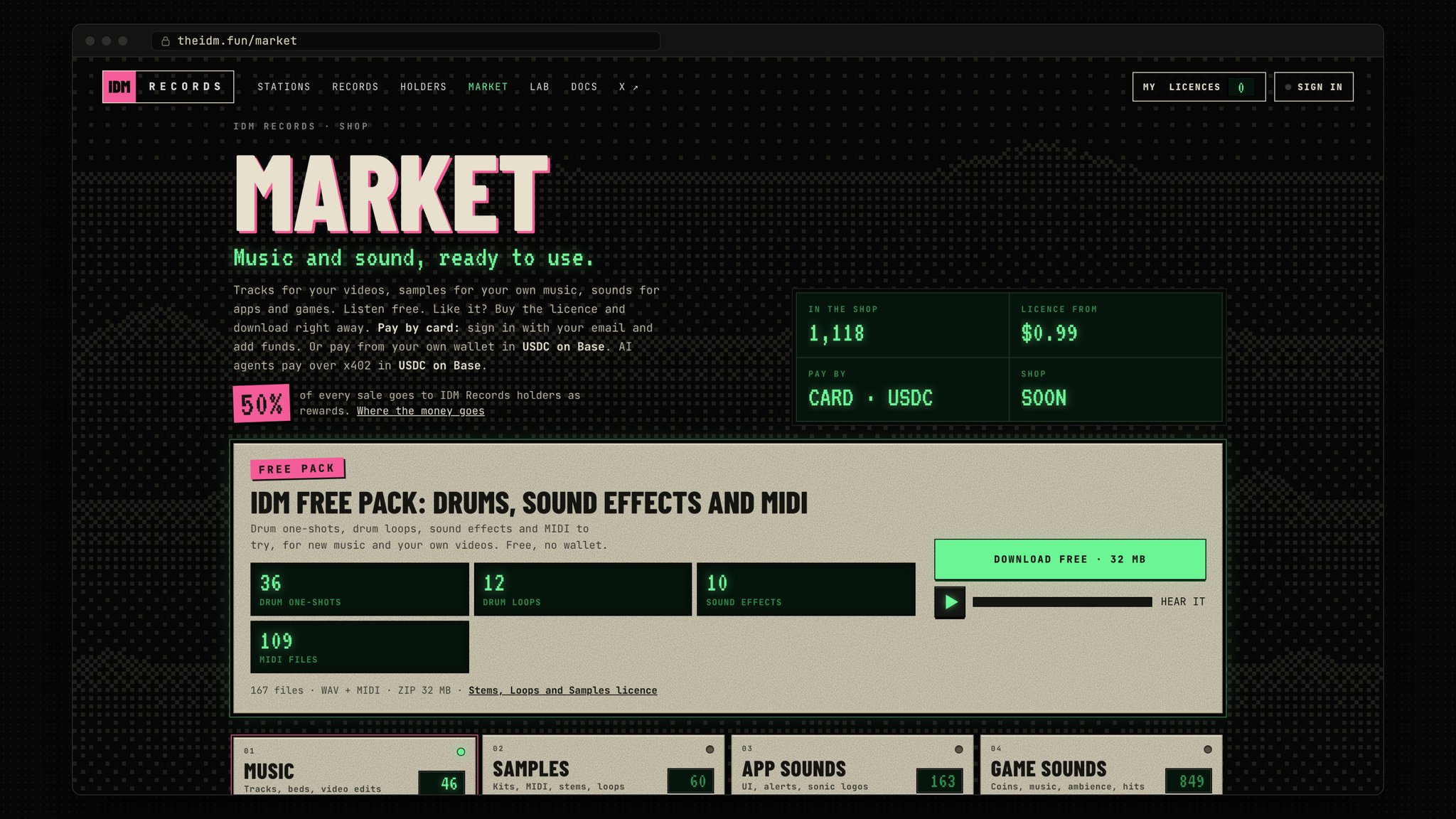
The catalog is available to anyone who needs music and sound:
- Music: tracks from every record and studio tracks from the label, with licenses for videos, podcasts, and streams. The Creator license costs $0.99, and the Commercial license costs $10. Background music of exact lengths and video edits of 6, 15, 30, and 60 seconds.
- Samples: drum kits, construction kits with MIDI, MIDI packs, synth voices from the label, stems, and loops for making your own music.
- App sounds: interface sounds, audio logos, and notification packs.
- Game sounds: game sound effects in different styles, game music, and ambient sounds.
- Free starter pack: drum hits, loops, effects, and MIDI. No wallet or registration needed.
The store will keep improving and expanding. We’ve built a universal engine that can generate tons of sounds for many different industries.
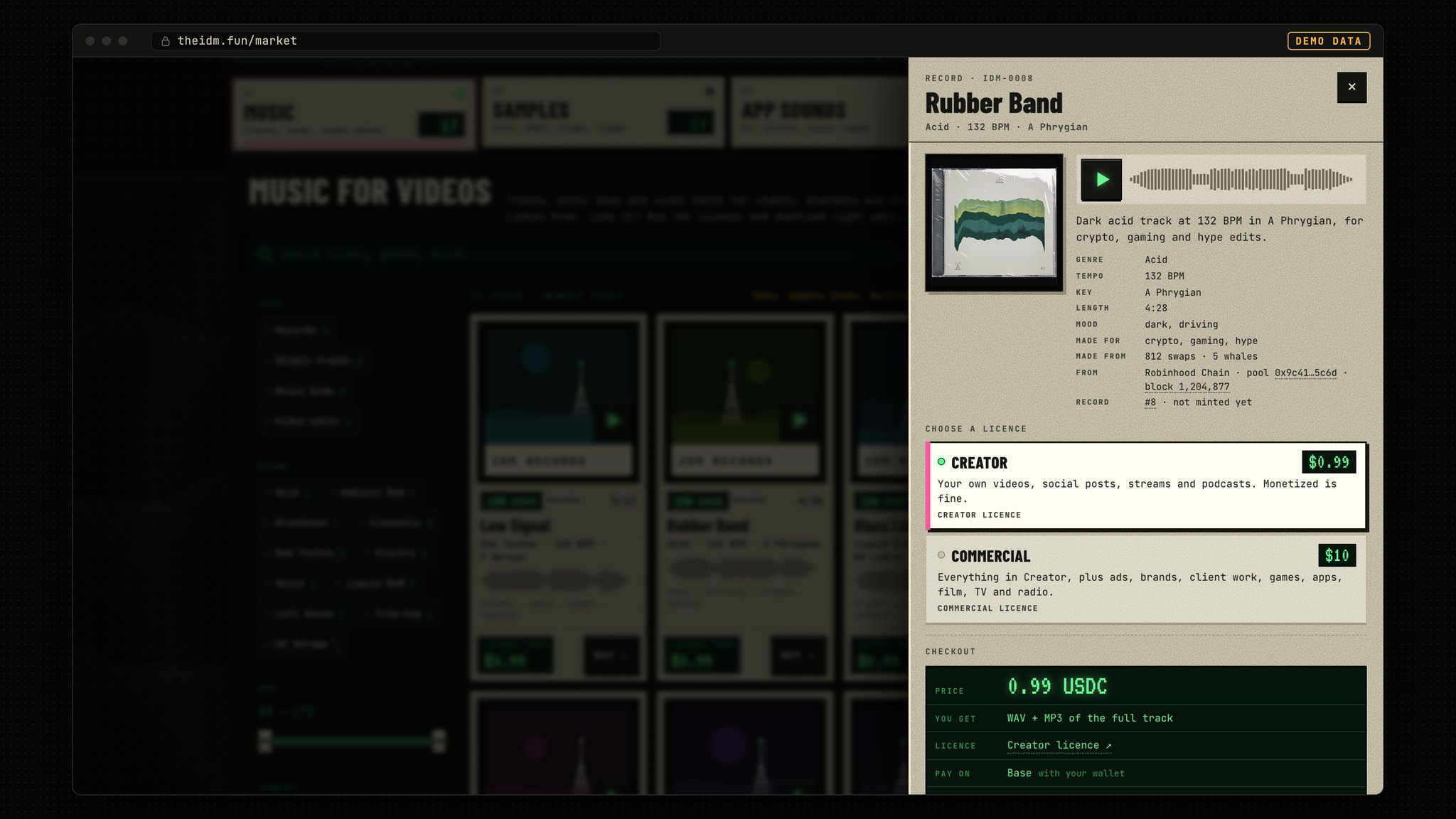
Listen for free. Like it? Buy a license and download the files right away. Sign in with your email, add funds with a card, and buy in one click. Or use your wallet. Every license has a public record that anyone can check.
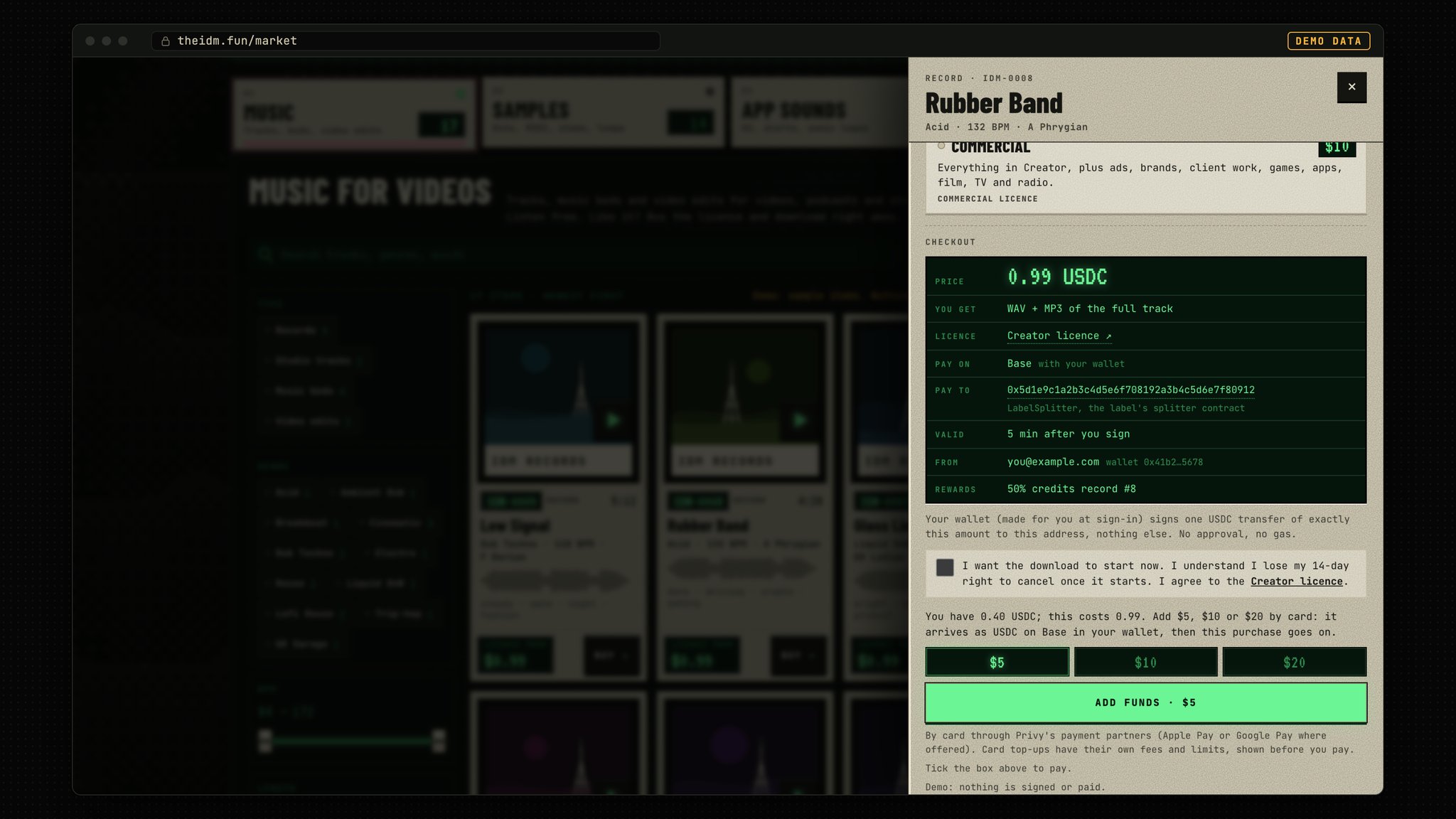
Email login and card payments
music for ai agents
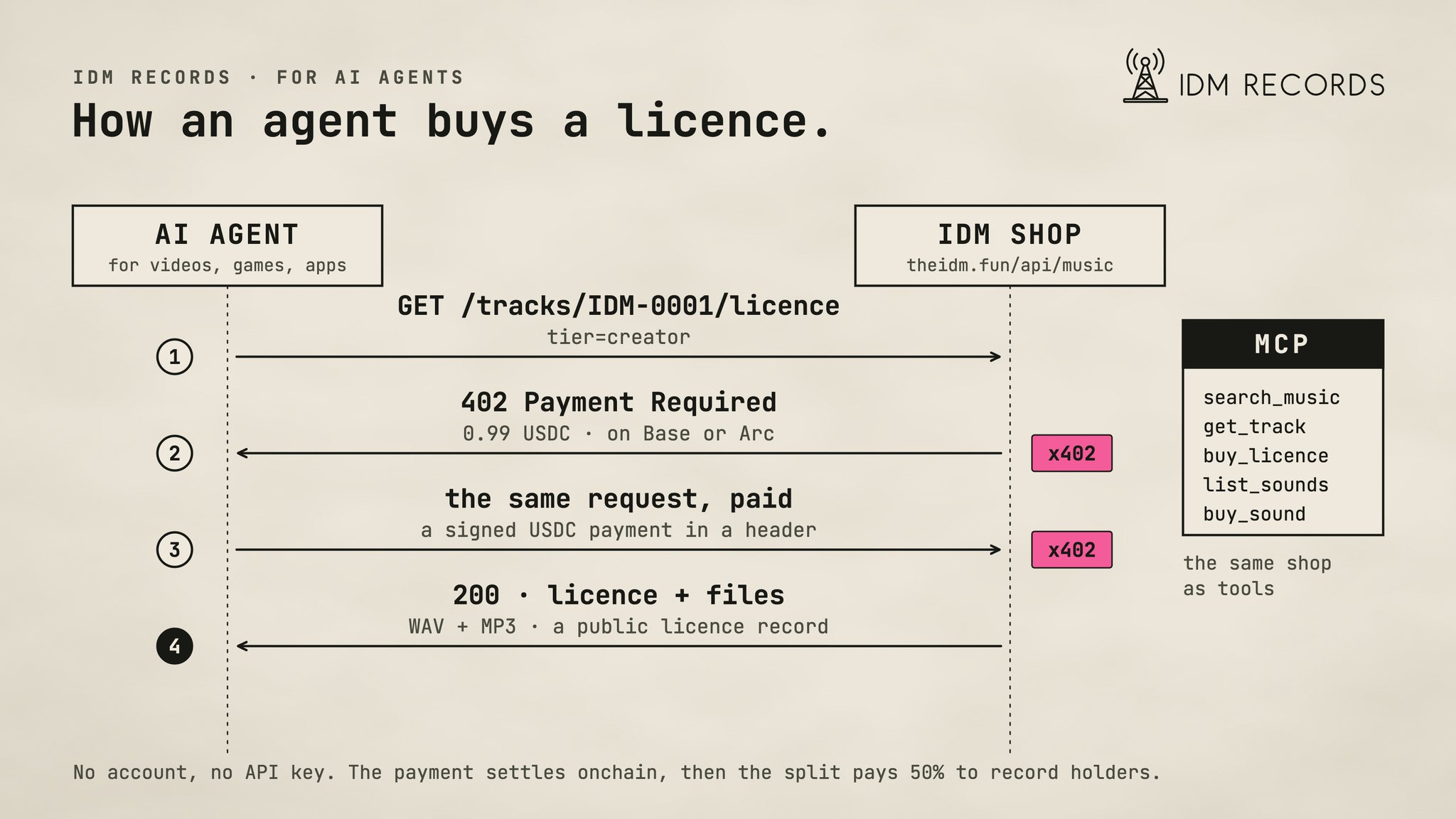
How an agent buys a license
AI agents create videos, games, and apps, and they need music they can legally use. IDM Records sells it directly to them.
The store speaks x402, payments built into HTTP. An agent asks for a license and gets back “402 Payment Required” with the price. It signs a USDC payment and asks again. The license and the files come back in the reply. No account, no API key. Agents can pay on Base or Arc.
An agent buys a track over x402 (Base Sepolia testnet, a real payment)
The store also speaks MCP. An agent can search the catalog by genre, tempo, key, mood and use case, and buy right there in the same chat.
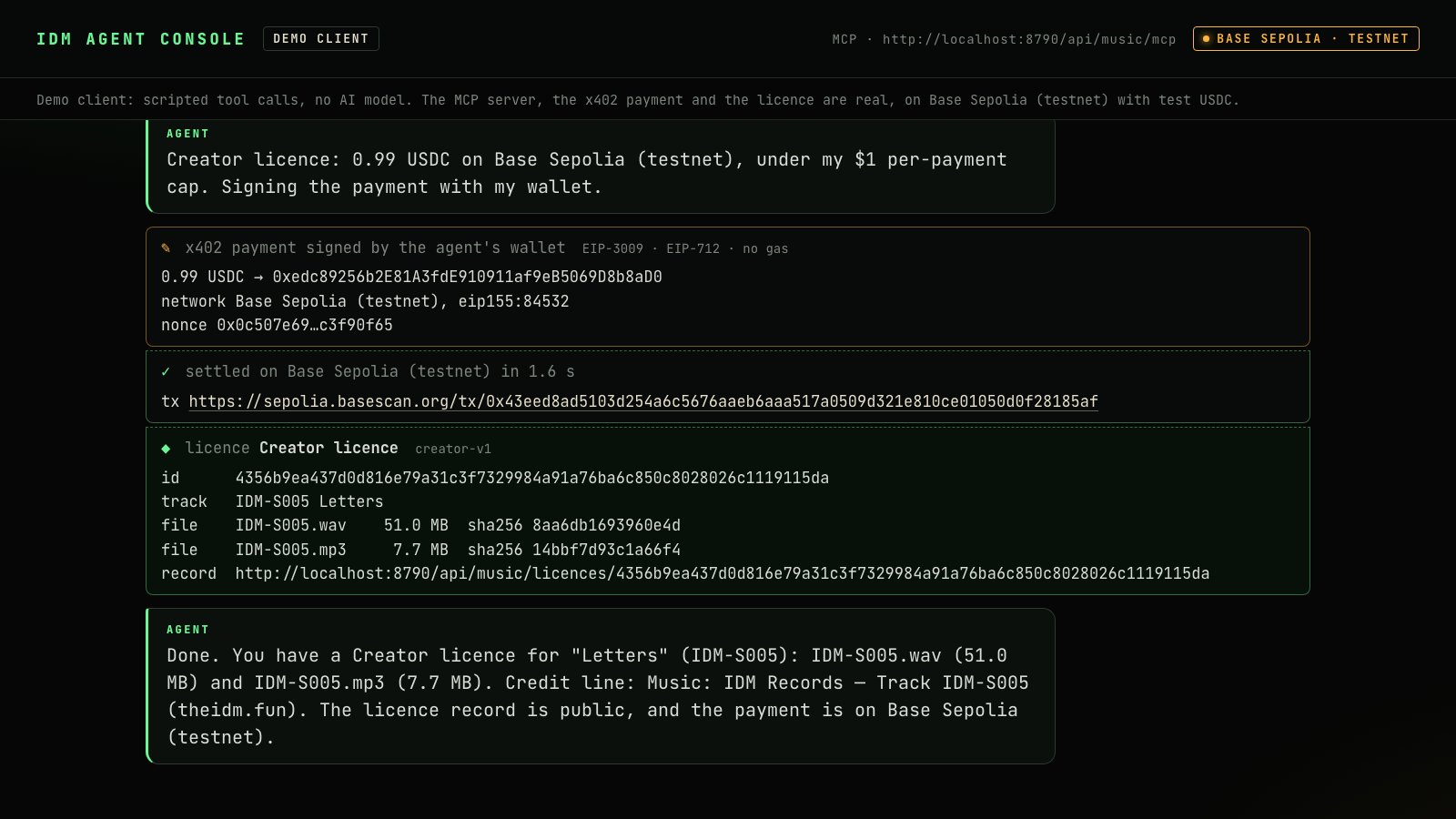
An agent searches and buys over MCP (demo client, real testnet payment)
the loop
More stations, more trades. More trades, more tracks. More tracks, a bigger catalog. A bigger catalog, more sales. More sales, more rewards for holders and more $IDM burned.
Drop 1 opens Wednesday, November 18, at 17:00 UTC. Check your status on the holders board and keep holding your $IDM.
Originally published on X ↗