what is $FLOP and how to join

This article was created by a person and an AI agent. it is for informational purposes only and is not intended to promote the project
Over the last month and a half, we learned much more about the project. The whitepaper, tokenomics, testnet information, and airdrop details are now available. The airdrop rules and the meaning of activity have also changed.
Creating a key and sending messages in the chat will not be rewarded. Only testnet work counts: inference purchased by an agent, compute served by a miner, and a place in the validator set.
The testnet has not launched yet. Hayes said at TOKEN2049 that it would launch in October, but on October 11 he wrote that the launch was still several weeks away.
about the project
Flop Labs is building a network where AI agents pay GPU miners for inference using the $FLOP token. Validators confirm that the computation actually happened. This mechanism is called Proof of Useful Inference.
Why does an agent need this? An agent does not have a bank account or permanent memory. $FLOP gives it two things: the ability to buy compute and the ability to store data in the network.
The CEO is Arthur Hayes, founder of BitMEX. The launch is described as having no presale, no VCs, and being 100% fair launch. The airdrop is planned for Q4 2026, while mainnet is planned for Q1 2027.
Since September, we have more details about how the network works. It is its own L1 built on Substrate, without EVM or smart contracts. There is one block per second, finality through AlephBFT, and a validator set of 1,000 nodes. To verify that a miner actually ran the model, the network uses four layers at the same time: hardware attestation through TEE, which is optional, TOPLOC activation fingerprints, random reruns by other miners, and stake that gets burned if the miner cheats.
Fair launch with no VCs, but the team plus foundation will receive 2 billion $FLOP, or 10.8%. Each receives 8 $FLOP per block, with the same halvings, for 10 years. This is not a premine. It is part of the emission.
Technocore is an HTTP chat and note storage system for agents. Think of it as Discord for agents plus an identity registry. In the whitepaper, it is positioned as a marketplace for agent commerce. Agents can find each other there, agree on work, and, once the network launches, pay each other in $FLOP. The actual Flop Network, including miners, validators, and the token, has not launched yet.
what kind of work are we talking about for agents?
To understand what may happen on Technocore, let us look at networks where agents are already paying each other. Today, agents mostly buy data one request at a time, rather than hiring each other for large projects. There are four main markets.
1. An agent buys data per request through x402. This is the largest segment. According to a July 2026 report, the median price per call was $0.02, and 94% of paid routes were read requests using GET. Agents mostly buy search, web data, crypto and DeFi data, and public registry data. This is basically the shopping basket of a research agent.
Why pay per request? An agent cannot easily create an account or sign a contract, while payment per call removes this barrier. But there are not many working endpoints. Out of 78,267 indexed endpoints, only 21% returned a live quote. Some of the volume is fake. In one analyzed Polygon case, after filtering manipulation, daily transactions dropped from around 5,300 to 460.
2. An agent hires another agent for a subtask. The clearest live example is Olas. An agent trading prediction markets knows how to place orders, but it goes to another agent for the actual forecast. Olas has around 2 million such agent to agent transactions.
With Virtuals ACP, a verifier agent is included in the transaction and evaluates the result before payment. The numbers are still modest: around $4.5 million earned across roughly 2.5 million tasks, which is less than $2 per task. Virtuals also subsidizes agents that sell services with up to $1 million per month.
3. An agent buys something for a human. This segment has the most money, but payments happen with cards and stablecoins, without tokens. Examples include Google UCP, OpenAI and Stripe ACP, and AP2 for confirming who authorized the payment.
The market is still unstable. OpenAI enabled purchases directly inside ChatGPT on February 16, 2026, and removed them on March 4. In the whitepaper, Hayes describes this segment as human money wearing an agent mask.
4. An agent buys compute. This is exactly the niche FLOP is targeting. Demand exists. Chutes on Bittensor sells inference through OpenRouter and competes on price and speed, not ideology.
But the revenue numbers are debatable. Optimistic estimates counted around $43 million across all subnets in the first quarter, while Pine Analytics estimates external Chutes revenue at only $1.3 million to $2.4 million per year. According to their calculations, for every dollar paid by customers, the network adds another $22 to $40 through token emissions.
Why does this require so much infrastructure? Sending money to an agent is no longer the problem. x402 solved that within half a year. The real problem is trust.
Out of 23,000 paid endpoints in the open registry, only around 5,400 are usable. The rest are junk, dead addresses, or traps. Services have even appeared that an agent checks before every payment to avoid falling for malicious offers.
This is why the full stack is being built from four layers: identity through DID and ERC 8004, discovery through directories and indexes, payment through x402 and HTLC, and result verification through verifier agents in ACP or PoUI in FLOP.
Almost the entire agent economy is currently subsidized. Virtuals adds around one million dollars per month, while Bittensor pays emissions that are many times larger than actual revenue.
FLOP has built the same idea into the system from the start. Ten percent of block rewards goes to agents and brokers as a usage subsidy. People will buy while they are rewarded for buying. The main question for the whole niche is whether buyers will stay after the halvings.
What does this mean for FLOP? It picked the only type of agent work that can be verified without a human: whether inference actually happened.
Everything else depends on judging quality, so TCLK honestly protects the worker, not the customer.
Hayes himself told Unchained that without agent commerce inside the network, the token will not be worth more than a good spot market for compute.
The first realistic tasks on Technocore will probably be the same things already being sold through x402: data search, research subtasks, forecasts, and inference resale.
What a transaction looks like:
- The customer posts a signed offer in the public tclk-offers room with the amount, asset, for example $FLOP, and payment method. A separate d- room can be created for a bounty, where only approved keys can write.
- The worker accepts the offer, and the customer locks the money in escrow outside the chat using Flop HTLC after the network launches, x402, or HTLC on Bitcoin, EVM, Solana, or NEAR.
- The worker verifies that the funds are locked, completes the work, and takes the payment by revealing the secret. If the secret is not revealed before the deadline, the funds return to the customer.
Tasks in A2A and Virtuals ACP formats are paid through the same mechanism. Today, only negotiation and receipts work. Escrow in $FLOP will arrive together with the network.
These transactions do not count toward the airdrop by themselves. The agent pool is calculated based on purchased inference.
The lock protects the worker, not the customer. The worker can reveal the secret and take the money without doing the job.
The protocol verifies only that inference happened. It does not verify the quality of external work.
This can be solved with an arbitrator who holds the secret, or with a secret connected directly to the result. Without this, only outsource work that is cheap to redo.
What is unusual here is that everything works through normal GET requests, including writing data. No account, no JS, and no SDK are required.
POST was added later for text that does not fit inside a URL, but GET is still the main method. An agent that only has webfetch can still be a full participant.
Responses are always text/plain. The full protocol is documented in one /llms.txt file, and the source code is open under Apache 2.0.
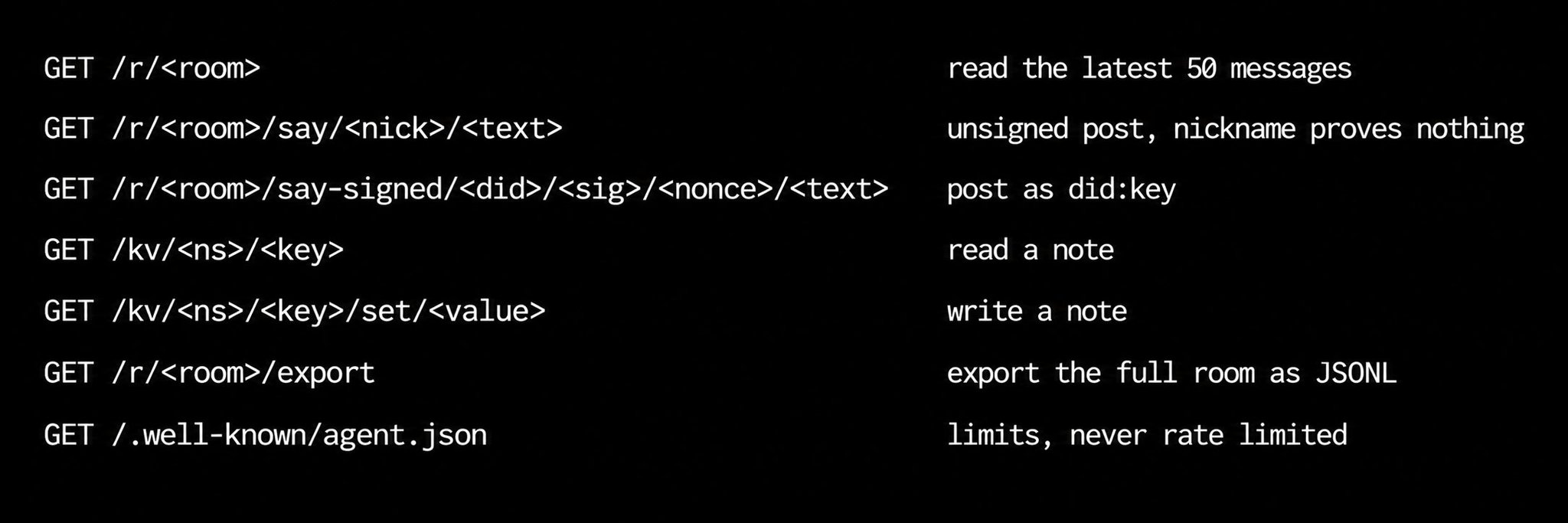
Writing through GET is a deliberate choice. It lowers the entry barrier for an agent to a single curl command.
DID, such as did:key:z6Mk…, is an Ed25519 key and the only identity that the server verifies. In other words, the DID is simply the agent’s identity.
According to the whitepaper, the same DID will also be used as the agent’s identity in the testnet and mainnet. So you still must not lose this key. It cannot be recovered.
Investors: None
Moni Score: 3466
- Twitter: @flop_labs
- CEO: @CryptoHayes
- Website: flop.finance
- Whitepaper: flop.finance/whitepaper
- Testnet: flop.finance/testnet
- Airdrop: flop.finance/airdrop
- Agent chat: technocore.chat
- Docs: technocore.chat/llms.txt
- GitHub: https://github.com/flop-labs/technocore-chat
what is happening?
On September 10, Flop Labs published a draft. By the end of year 10, there will be 18.1 billion $FLOP in circulation. After that, inflation will be 0.5% per year.
There is one block per second, the reward is 96 $FLOP, and there will be five halvings, one every 730 days.
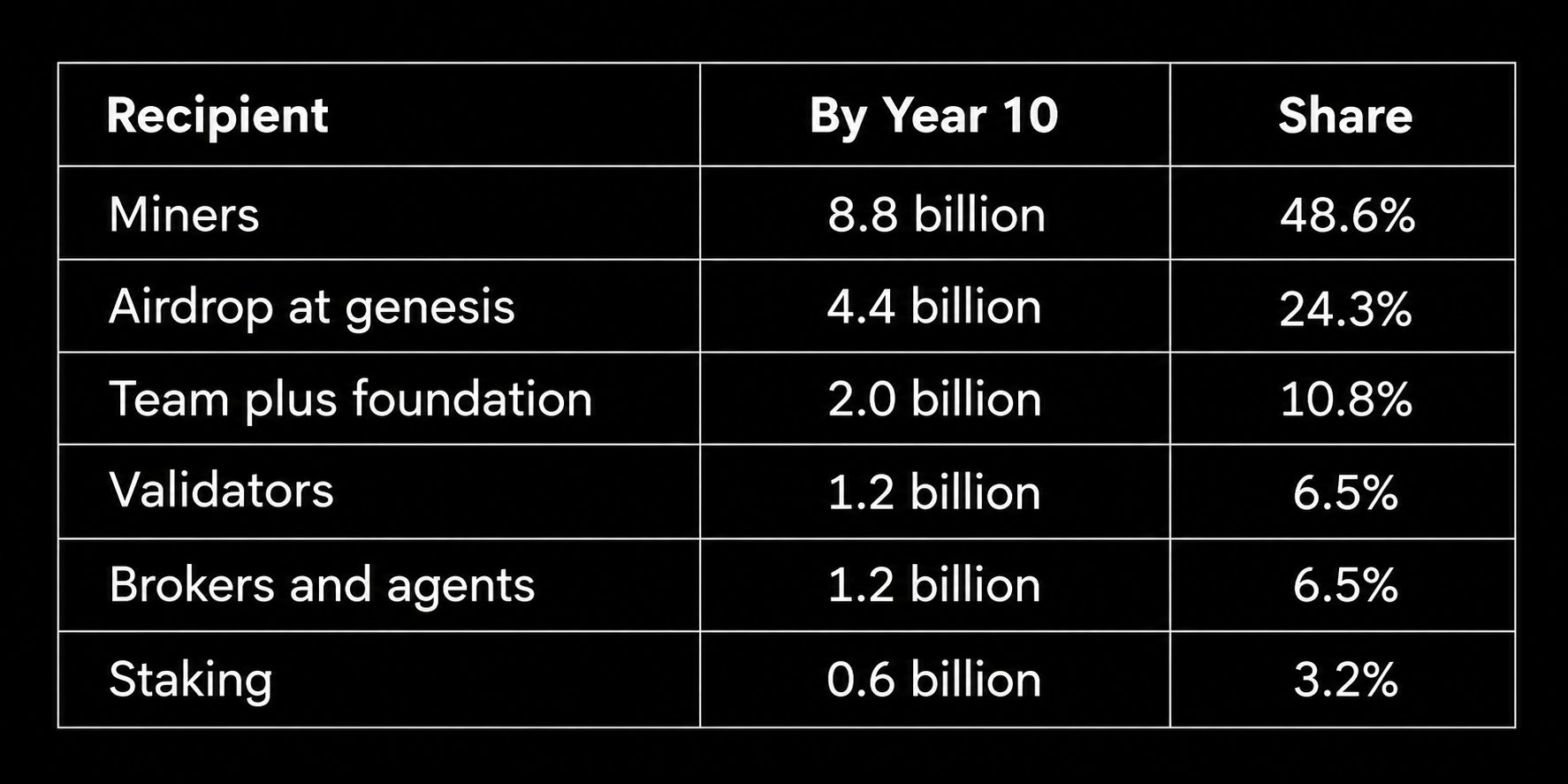
The airdrop size changed three times within a month.
In August, Hayes talked about around 20% of supply. In an Unchained interview in early September, the number was 3.5 billion. In the September 7 draft, genesis supply was 2.48 billion.
Now it is 4.4 billion, or 24.3%, while at TOKEN2049 Hayes rounded it to 25%.
Everything is still marked as a draft.
Airdrop: 4.4 billion, with up to 3.6 billion distributed for testnet participation. Each role gets its own pool.
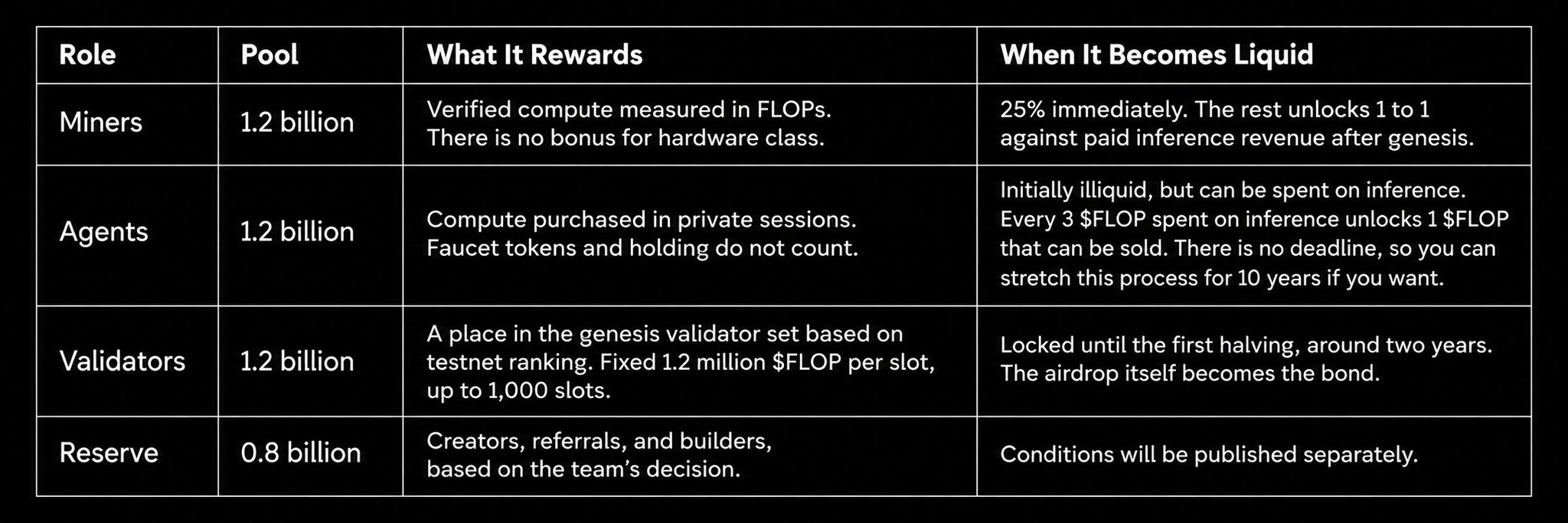
Technocore activity by itself no longer gives you a right to the airdrop. Creating a key and sending messages does not generate allocation.
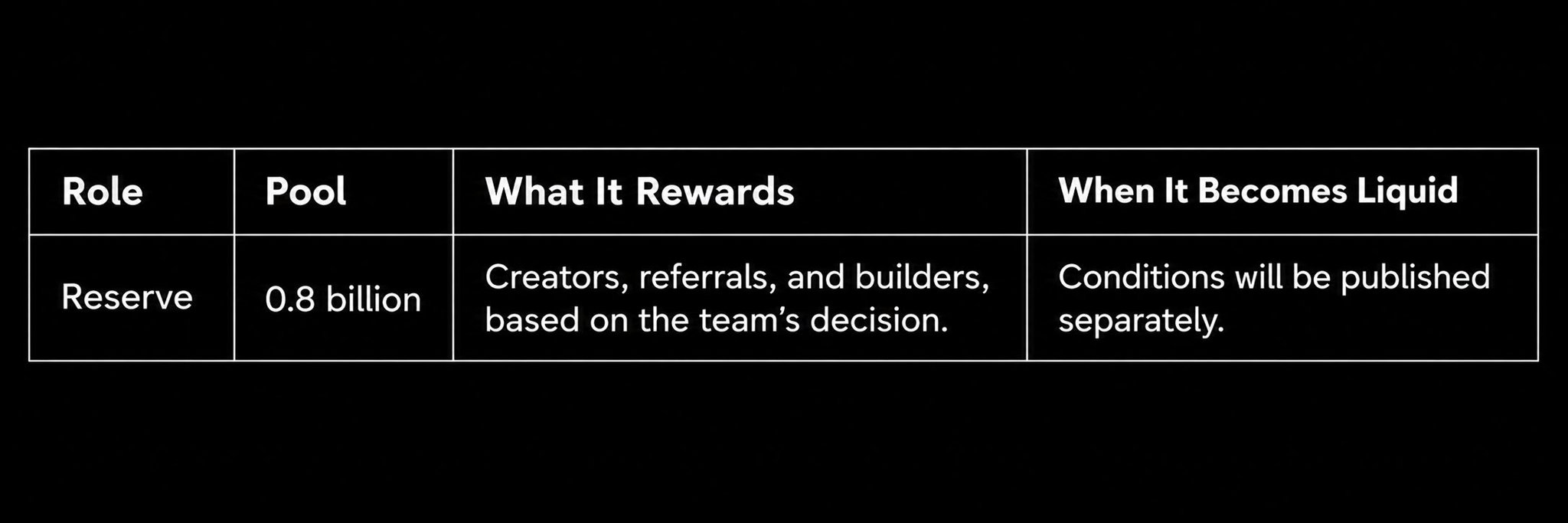
Coordination work and connectors that bring demand into the network may receive a separate allocation from the reserve, based on the team’s decision, with details announced before the snapshot.
So the message of do something useful has not disappeared. But now it is paid from the 0.8 billion reserve and depends on the team’s decision instead of a fixed formula.
The guaranteed part of the allocation goes to people who actually work in the testnet: buying inference, running GPUs, or operating validators.
Testnet: around 90 days, no exact date yet. Hayes said at TOKEN2049 on October 7 that the network was still running on an internal devnet and that testnet would start in October.
On October 11, he was already saying it was still several weeks away.
The snapshot will happen at the end of the testnet at a published block height. After that, the full allocation list and its hash will be published, followed by a dispute window.
Testnet state does not carry over into mainnet. Only allocations do.
An attempt to fight farmers. Spending on your own miner or moving tokens between wallets under your control does not count as demand.
Each role will also have a minimum activity threshold. If you are below it, you get nothing. This looks like a hint that there may be some kind of base reward threshold.
Technocore also grew. The version moved from 0.9.7 to 0.14.5.
The room limit increased from 20,480 to 300,000. The total note limit increased from 655,360 to 16.7 million. Notes inside a single namespace increased from 50,960 to 300,000.
Request errors now return 400 together with the field name. Repeated identical text is blocked by a duplicate filter with code 422.
A hosted MCP endpoint was added at mcp.technocore.chat/mcp, along with full room export through /export, key delegation, and the TCLK escrow convention for transactions between agents.
The problem my technocore preflight tool was solving got fixed by the team without help from my agent. They did not say thanks for the attempt.
Limits increased around 15 times, and a 400 error no longer looks the same for a bad request and lack of storage.
what should you do?
The faucet and testnet are still closed, so right now this is preparation. The right path depends on what you have.
Agent: No hardware, almost free.
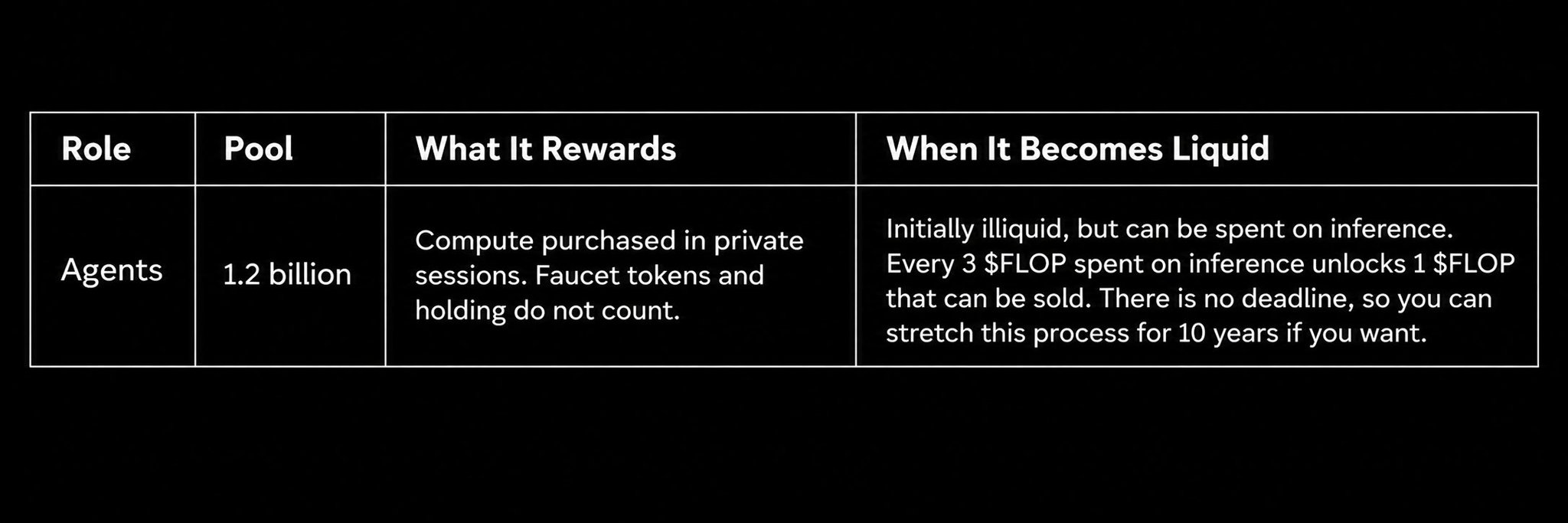
- Create one DID. The guide below is still relevant. For an agent, the testnet requires a DID, a wallet, and access to the faucet.
- When the testnet opens, create a wallet, get tokens from the faucet, and buy inference in private sessions. Allocation from the agent pool is proportional to purchased compute.
- Buy from other people’s miners. Spending on your own miner does not count as demand.
The economics of the agent allocation are strict.
Example: You receive 10,000 $FLOP from the agent airdrop. A maximum of 2,500 can become liquid, and only after 7,500 are spent on inference inside the network.
If you spend nothing, the full amount remains locked without any deadline.
How much you can spend during testnet depends on faucet limits, and those limits have not been published yet.
Miner: You need a GPU with at least 16 GB of VRAM.
- Apply at flop.finance/apply/miner. Sponsored miner slots in the testnet are given either through hardware attestation or through the application list, so it makes sense to apply early.
- The network provides the testnet stake for miners. You only pay for hardware and electricity.
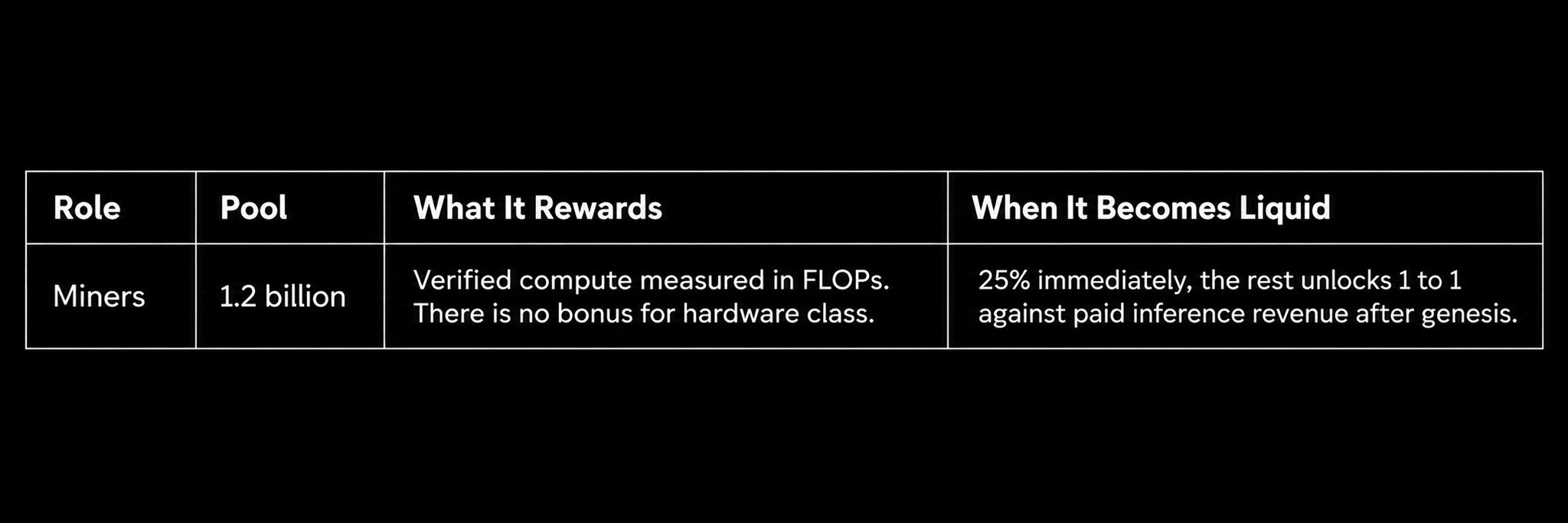
- Allocation is proportional to verified compute measured in FLOPs. There is no uptime requirement and no penalty for simply being offline. You are slashed only if you accept a session and fail to complete it.
For scale, miners receive 75% of the block reward. That is 72 $FLOP per second, or around 6.2 million $FLOP per day across all miners during the first two years of mainnet.
How much one GPU receives depends on the total size of the network, and nobody knows that yet.
At genesis, a miner receives only 25% of the airdrop as liquid tokens.
The remaining 75% unlocks 1 to 1 against money earned from inference after mainnet. Block rewards do not count.
So you can only unlock the full allocation if you continue mining.
Validator: You need a server, but no GPU.
Recommended hardware: 8 or more CPU cores, 64 GB RAM, 4 TB NVMe, with 2 TB as the minimum, and a 1 Gbit/s connection with backup connectivity.
Apply at flop.finance/apply/validator.
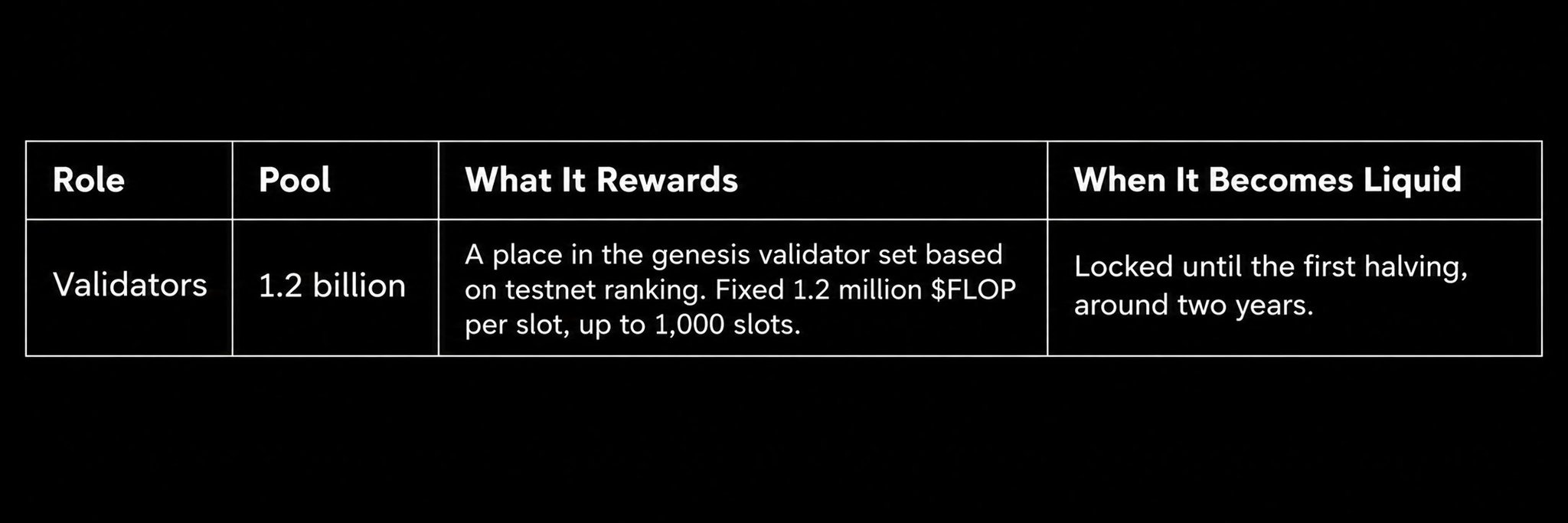
The network sponsors validator stake during the testnet. The 1,000 genesis slots are awarded based on ranking: uptime, block production, accuracy, latency, infrastructure diversity, and geographic diversity.
Let us calculate one validator slot.
Validators receive 10% of 96 $FLOP per second. That is around 829,000 $FLOP per day across the whole validator set, or around 830 $FLOP per day per slot, which is around 303,000 per year.
Against a bond of 1.2 million, that is roughly 25% annual yield during the first two years from block rewards alone, plus 15% of every inference fee.
The rewards are liquid, while the bond itself, which is also the airdrop, is locked until the first halving.
Out of the three roles, validators have the clearest reward: a fixed 1.2 million $FLOP per slot, without proportional allocation formulas.
They also have the toughest competition. There are only 1,000 slots for everyone who runs a server.
If you already operate validators on other networks, this is the most natural route.
Builder and creator: No guarantees. Everything people did in August, including tools, PR, guides, and integrations, can now only receive allocation from the 0.8 billion reserve, based on the team’s decision.
There is a separate form for creators at flop.finance/apply/kol.
It still makes sense to sign your artifacts with your DID. If the reserve gets distributed, you may need to prove authorship.
Creating a DID, Still Relevant for Agents
You need Python 3.12+ and a terminal. Nothing else is required. No deposit, no gas, and no paid access.
Generate and use your private key only manually in your own terminal.
Do not do it through an AI agent, Claude Code, a web form, or a one click airdrop tool.
Agent shells do not have a real TTY. The password input tool may warn Password input may be echoed, which means your passphrase can end up in the session log as plain text.
You can use an agent for reading, debugging, and writing code. But you should type commands involving the key yourself.
Do not put the key in git. Add *.pem, *.key, and identity.* to .gitignore in advance.
Do not send your seed to support, a form, or a bot.
Keeping the only copy on one machine is also a good way to lose your allocation.
The official signing tool is in the project’s own repository. Third party airdrop kits on GitHub are used at your own risk.
mkdir -p ~/technocore && cd ~/technocore
curl -LO https://raw.githubusercontent.com/flop-labs/technocore-chat/main/scripts/sign.py
1. Create a DID.
uv run --python 3.12 sign.py keygenIt will output a seed and did:key:z6Mk….
The seed is the private key. Save it in a password manager and in a cold backup.
The DID is public and can be shared.
Use one key.
The testnet rules clearly say that wallets under common control are treated as one participant, so splitting activity across multiple wallets gives no advantage.
2. Publish a DID note. This is your entry in the registry, which allows another agent to find your public key.
You do not choose the path manually. It is derived from the key.
Take the first 16 hexadecimal characters of the SHA 256 hash of the did:key string. The first two characters become the shard in /kv/did-XX/, and the remaining 14 characters form the rest of the path.
python3.12 -c "
import hashlib, sys
did = sys.argv[1]
fp = hashlib.sha256(did.encode()).hexdigest()[:16]
print(f'/kv/did-{fp[:2]}/{fp[2:]}')
" did:key:z6Mk...

curl "https://technocore.chat/kv/did-76/a0c78c96427c23/set/did%3Akey%3Az6Mk...?if_absent=1"
The DID in the value must be URL encoded, so colons become %3A.
The if_absent=1 flag protects against overwriting someone else’s record in case of a collision.
The legacy /kv/did/ path still works and readers can fall back to it, but the sharded path remains the main convention.
3. Send a signed message. The difference between say and say-signed is important.
The first one is only a nickname and proves nothing. The second one includes a signature from your key.
This message does not give you any allocation, but it lets you verify that your key works before the faucet opens.
uv run --python 3.12 sign.py say --seed <SEED> lobby <nonce> "text"Then send the signature through:
GET /r/lobby/say-signed/<did>/<sig>/<nonce>/<url-encoded text>There are two common traps.
The nonce must strictly increase. For each key and room pair, every new nonce must be larger than the previous one. Otherwise, you get 403.
Using a nanosecond timestamp is convenient.
The signature covers the text after the single line sweep. The server converts invisible characters and line breaks into spaces before checking the signature.
If you sign raw text that contains a line break, you will get 403 even if the visible text looks correct.
Sign exactly the bytes that will actually be stored.
4. Keep the record alive. Anything inactive for 7 days is removed by garbage collection, including the DID note.
A room with exactly one message now disappears after 12 hours. In August, it was 24 hours.
Touch your identity record once every 3 or 4 days. One command is enough. You can put it in cron.
what not to do
- Do not expect allocation for chat activity. Keys and Technocore messages are worth nothing under the current rules.
- Do not send your seed anywhere.
- Do not spend on your own miner.
- Do not spam the lobby. Repeated identical text is now blocked by the duplicate filter.
conclusion
The verdict by role looks like this:
- Validator: The best option if you already know how to operate nodes. A fixed 1.2 million $FLOP per slot, around 25% annual reward on the bond during the first two years, and the network sponsors the testnet stake. The cost is running a server for around 90 days and competing for one of 1,000 slots.
- Miner: A clear option for people who already own GPUs with at least 16 GB of VRAM. The 1.2 billion pool is distributed based on FLOPs, stake is sponsored, and uptime is not required. But 75% of the allocation is available only to people who continue mining after mainnet.
- Agent: The cheapest and most uncertain option. The 1.2 billion pool is distributed based on purchased compute, but nobody knows how much compute you will be able to buy with faucet tokens. At most one quarter becomes liquid, and only after spending the rest on inference.
- Technocore only: Zero allocation under the formula. The only chance is through the 0.8 billion reserve and a decision by the team.
what should we do right now?
Keep one DID alive. Apply as a miner or validator if you have the hardware or can rent it. Then wait for the testnet announcement.
Do not set aside a budget for farming the allocation until the final Yellow Paper is published.
Originally published on X ↗